
Industry data
The 2026 Public Adjuster Claim File Anatomy: How Many Photos, Pages, and Days a Real File Holds
What a complete residential claim file actually looks like—by the numbers.
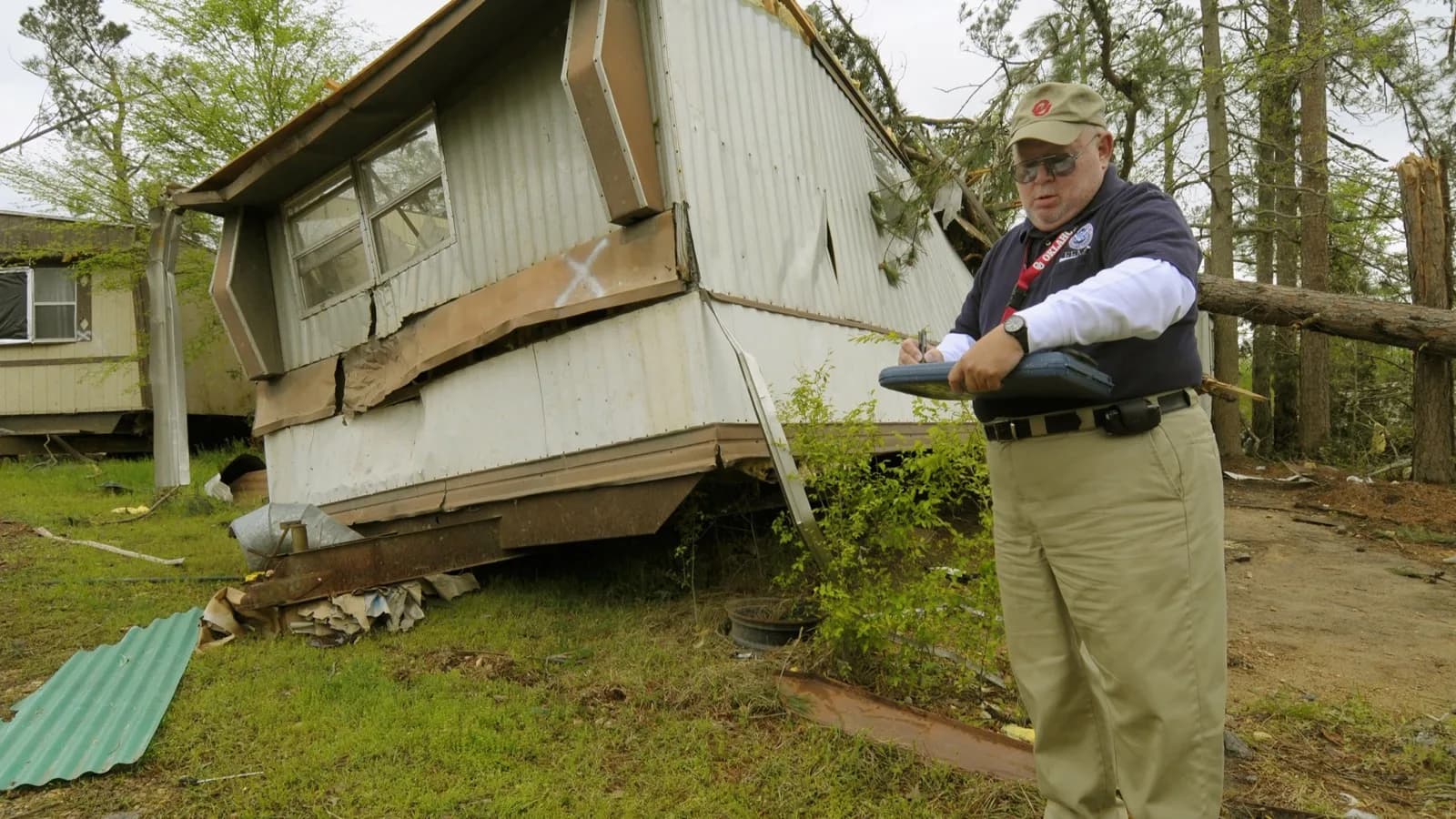
Photo: FEMA / Win Henderson — public domain
In short
How many photos, pages, and days a real claim file holds — documentation volume by peril, the ten document categories a file needs, and the TX, FL, and CA statutory clocks.
Print a fully documented hurricane claim and it will not fit in one banker's box. The policy runs past eighty pages before the first endorsement. The photo log crosses a thousand frames. Add the estimate, three rounds of supplements, an engineer's report, a room-by-room contents inventory, a weather certificate, and eight months of carrier letters, and one loss becomes a stack you measure in inches. Public adjusters talk about claims in dollars. Measured the other way — in pages, photos, and days — the file is the thing the settlement actually rests on.
Ask ten adjusters what a finished claim file weighs and you get ten shrugs, because nobody counts. The count matters anyway. A carrier's desk reviewer settles against whatever exists at the moment of inspection, and a thin file settles thin. What follows is the anatomy of a residential property claim by the numbers — how many pages, how many photographs, how many documents by category, and how many days from first notice to the check that closes it. The ranges are wide because loss complexity is wide. The floor of each range is the part that should worry you.
How many pages a file actually runs
Start with the contract, because every coverage argument ends there. A homeowners policy written on the standard ISO HO-3 form is rarely the fifteen-page booklet homeowners picture. The base form runs roughly 20 to 25 pages on its own; add the declarations page, the schedule of forms and endorsements, and the mandatory state amendatory endorsements, and a complete residential policy package lands at 60 to 90 pages — higher once the insured has scheduled personal property, ordinance-or-law, or water-backup coverage. Publicly posted consumer sample policies from the large national carriers sit in that same band. Commercial property is heavier: a building-and-personal-property form paired with a causes-of-loss form and its endorsements commonly clears 100 pages. If you cannot point to the exact endorsement governing a disputed item, you have not finished reading the policy, and a 70-page policy is where that reading happens.
The policy is the smallest stack that matters. The sworn proof of loss adds only a few pages but carries the weight of the whole claim. The estimate runs 8 to 14 pages on a contained kitchen water loss and past 80 on a full fire rebuild, and every supplement is a new document — complex claims commonly cycle three to five rounds before settlement. Carrier correspondence, indexed from first notice through final payment, stacks 20 to 60 pages on a contested file, and it is where a bad-faith timeline lives. Expert reports are situational and heavy: a structural engineer's letter on a wind claim runs 10 to 20 pages, an industrial hygienist's mold assessment 15 to 35, and a fire contents inventory can run 100 pages by itself.
How many photographs, by peril
Photographs are the largest single component of any file by item count, and the number scales with the peril. A roof claim documented elevation by elevation — every slope, the ridge, the flashings, the accessories, plus interior and attic confirmation — runs 60 to 120 frames. Hail work carries more, because each test square is shot with a reference and a measurement, the discipline the Haag Engineering inspection method is built around, and because OSHA fall-protection rules mean much of a steep roof gets photographed from fixed, safe positions rather than freely walked, so the adjuster shoots more frames to cover the same area. A single-floor water intrusion loss — the failed component, moisture readings at each point, open-cavity shots after the drywall is cut, post-drying confirmation — runs 80 to 160. Add mold and the file crosses 150 to 300, as containment, sampling locations, and pre- and post-remediation states each earn their own frames. Fire is the heaviest: a partial fire starts at 200 and a total loss runs 400 to 800 or more, room by room and structural member by structural member. A hurricane file spanning roof, water intrusion, contents, and outbuildings lands between 250 and 600 and climbs from there. The principle under the counts is the one Xactimate documentation guidance states plainly: a line item without a photograph is a line item the carrier can question.
How many documents, by category
Pages and photos are the volume. Categories are the structure — the file either holds each kind of document or it carries a gap the carrier will find. Ten categories run a residential property claim.
| Document | Typical volume | Who provides it | Criticality | Time to obtain |
|---|---|---|---|---|
| Policy + endorsements | 60–120 pages | Carrier / insured's declarations | Must-have | 1–3 weeks on request |
| Sworn proof of loss | 2–6 pages | Public adjuster / insured | Must-have | Days to draft |
| Photographs | 60–800+ frames | Field inspection | Must-have | Day of inspection |
| Estimate (Xactimate) | 8–80+ pages | Public adjuster / contractor | Must-have | 1–2 weeks |
| Engineer / expert report | 10–35 pages | Licensed engineer or hygienist | Situational | 2–6 weeks |
| Contents inventory | 5–100+ pages | Insured / inventory service | Situational | 2–8 weeks |
| Weather / causation record | 1–15 pages | NOAA / verification vendor | Must-have on weather losses | 1–5 days |
| Carrier correspondence log | 20–60 pages | Both parties | Must-have | Ongoing |
| Permit + code records | 1–10 pages | Local building department | Situational | 1–4 weeks |
| Mitigation invoice + drying log | 5–30 pages | Restoration contractor | Must-have on water losses | Days to 1 week |
The situational documents are where files diverge. Two claims for the same loss can carry the same policy and the same photo count and still settle apart, because one added the engineer's report and the permit record and the other stopped at the estimate.
How long, from first notice to settlement
Then there is the clock, which every state writes differently. Three of the largest property markets set three different tempos, and reading one wrong costs leverage on a stuck file.
Texas runs on the Prompt Payment of Claims statute. Under Insurance Code § 542.055 the carrier has 15 days from notice to acknowledge the claim, begin its investigation, and request the items it needs. Under § 542.056 it must accept or reject in writing within 15 business days of receiving those items — a window it can extend by up to 45 days with a stated reason. Once it accepts, § 542.057 gives it 5 business days to pay, and § 542.058 sets an outer limit of 60 days. Miss the deadlines and the carrier owes the claim plus 18 percent annual interest and attorney fees.
Florida rewrote its clock in the SB 2-A reforms that took effect March 1, 2023, and this is where a widespread error still circulates: many summaries and older templates cite a 90-day pay-or-deny deadline. That ceiling is gone. Under the current § 627.70131 the carrier must review and acknowledge a claim communication within 7 days, conduct any physical inspection within 30 days, and pay or deny within 60 days of notice — with a single 30-day extension available only when the Office of Insurance Regulation declares a state of emergency. If your leverage argument still quotes 90 days, it is quoting a repealed number.
California works off the Fair Claims Settlement Practices Regulations that enforce Insurance Code § 790.03. Under 10 CCR § 2695.5 the insurer has 15 calendar days to acknowledge a claim and begin its investigation. Under § 2695.7 it must accept or deny within 40 days of receiving proof of claim, pay within 30 days of a settlement, and send the policyholder a written status update every 30 days until it decides.
Statutes set the ceiling; actual cycle times sit under it for clean claims and blow past it for complex ones. Florida's Office of Insurance Regulation puts the average insurer close time near 57 days from the date a claim is reported, with a median of 27. A contested mold scope, an appraisal demand, or a code-upgrade supplement routinely runs 150 to 300 days from date of loss to final payment, and catastrophe claims after a declared hurricane have averaged past 200 days in recent seasons as inspection backlogs stack up. The statutory clock is the leverage; the median is the reality; the gap between them is the negotiation.
What separates a well-documented file from an underdocumented one
Put two files side by side and the difference is not talent. A hail claim carried to settlement with 400 photographs, a test-square protocol, a matched NOAA storm record, and the policy language that ties the loss to a covered peril is a different claim from one built on 60 photos and a contractor's estimate — not because the damage differs but because one file survives a reinspection and the other cannot. The carrier's reviewer cuts what the file cannot support. A 400-page file in appraisal is harder to reduce than a 40-page file, line for line, because every disputed item has a photograph, a measurement, or an expert behind it. Scope gaps are where settlement dollars leak, and a scope gap is simply documentation that stopped before the file was finished.
The floor is the number that matters. A file sitting at the low end of every range in this piece is not a small claim — it is an underdocumented one, and it settles against its own gaps. Build to the ceiling before you submit, not after the carrier's first offer comes back short.
Every document named here — the 70-page policy, the 400 photographs, the supplement rounds, the correspondence log, the statutory clock — usually lives in a different tool. The policy is a PDF buried in email, the photos are on a phone, the estimate is in Xactimate, and the deadlines are in someone's head. The cost of that spread is the distance between what the file holds and what anyone can actually find under deadline. claimOS for public adjusters keeps the whole anatomy on one file — policy, photographs tagged by room and elevation, estimate and supplement rounds, correspondence, and the statutory clock in one place — and Claim Brain reads across every document in it, so the engineer's report, the moisture map, and the endorsement that governs the disputed item surface together instead of one email at a time. Compare public adjuster software to see how a claim-centric system differs from running the same file across a dozen tabs.
How many pages is a typical homeowners policy?
The base ISO HO-3 form runs about 20 to 25 pages, but a complete residential policy package — declarations, schedule of endorsements, state amendatory endorsements, and any added coverages — usually lands at 60 to 90 pages. Commercial property forms with their causes-of-loss forms and endorsements commonly clear 100 pages. The number that matters is not the total but whether the exact endorsement governing a disputed item is in your copy.
How many photographs does a claim file really need?
It scales with the peril: 60 to 120 frames for a roof claim documented elevation by elevation, 80 to 160 for a single-floor water loss, 150 to 300 once mold is involved, 200 to 800 or more for fire, and 250 to 600 for a hurricane spanning multiple damage types. Under 60 photos on a multi-room loss is a documentation gap a carrier will notice, because a line item with no photograph is one the carrier can question.
How long does a carrier have to pay a property claim?
It depends on the state. Texas sets a 60-day outer limit under Insurance Code § 542.058, with an 18 percent penalty for delay. Florida requires pay or deny within 60 days under § 627.70131. California requires an accept-or-deny decision within 40 days of proof of claim and payment within 30 days of settlement. Track the notice date precisely — not the inspection date or the estimate date — because that is when the clock starts.
Did Florida's claim payment deadline change?
Yes. The SB 2-A reforms effective March 1, 2023 cut the pay-or-deny deadline in § 627.70131 from 90 days to 60 days, tightened acknowledgment to 7 days, and required physical inspection within 30 days. A single 30-day extension applies only during a declared state of emergency. Any summary still citing a flat 90-day deadline is quoting a repealed number.
What is the most commonly missing document in a contested file?
On water and mold files it is the pre-remediation moisture map with reading points and values, because drying contractors often produce abbreviated reports. On any file, it is the endorsement schedule that proves the disputed coverage, and on an appraisal-bound file it is the expert report — a structural engineer, industrial hygienist, or forensic meteorologist — that supports scope the carrier is disputing on causation grounds.
Sources cited
- Texas Insurance Code Chapter 542 — Prompt Payment of Claims (§§ 542.055–542.058)— Texas Legislature
- Florida Statutes § 627.70131 (2023) — Insurer duty to acknowledge, investigate, and pay or deny claims— The Florida Senate
- Cal. Code Regs. Tit. 10 § 2695.7 — Fair Claims Settlement Practices; standards for prompt settlement— Cornell Legal Information Institute
- Fair Claims Settlement Practices Regulations (enforcing Insurance Code § 790.03)— California Department of Insurance
- 2025 Property Insurance Stability Report — insurer close-time and cycle data— Florida Office of Insurance Regulation
- NAIC property & casualty consumer resources and claims data— National Association of Insurance Commissioners
- ANSI/IICRC S500 Standard for Professional Water Damage Restoration — documentation guidance— Institute of Inspection, Cleaning and Restoration Certification
- OSHA fall protection standards for roofing work— Occupational Safety and Health Administration
Your own benchmarks, not just the industry's.
claimOS reporting shows cycle times, settlement patterns, and carrier response behavior across your own portfolio, so you can compare your desk against the numbers in posts like this one.