
Workflow — hail claims
How a Public Adjuster Documents a Hail Roof So It Survives Re-Inspection
A test square per slope, an honest read of each mark, the storm's own record, and the exclusion you already know is coming.
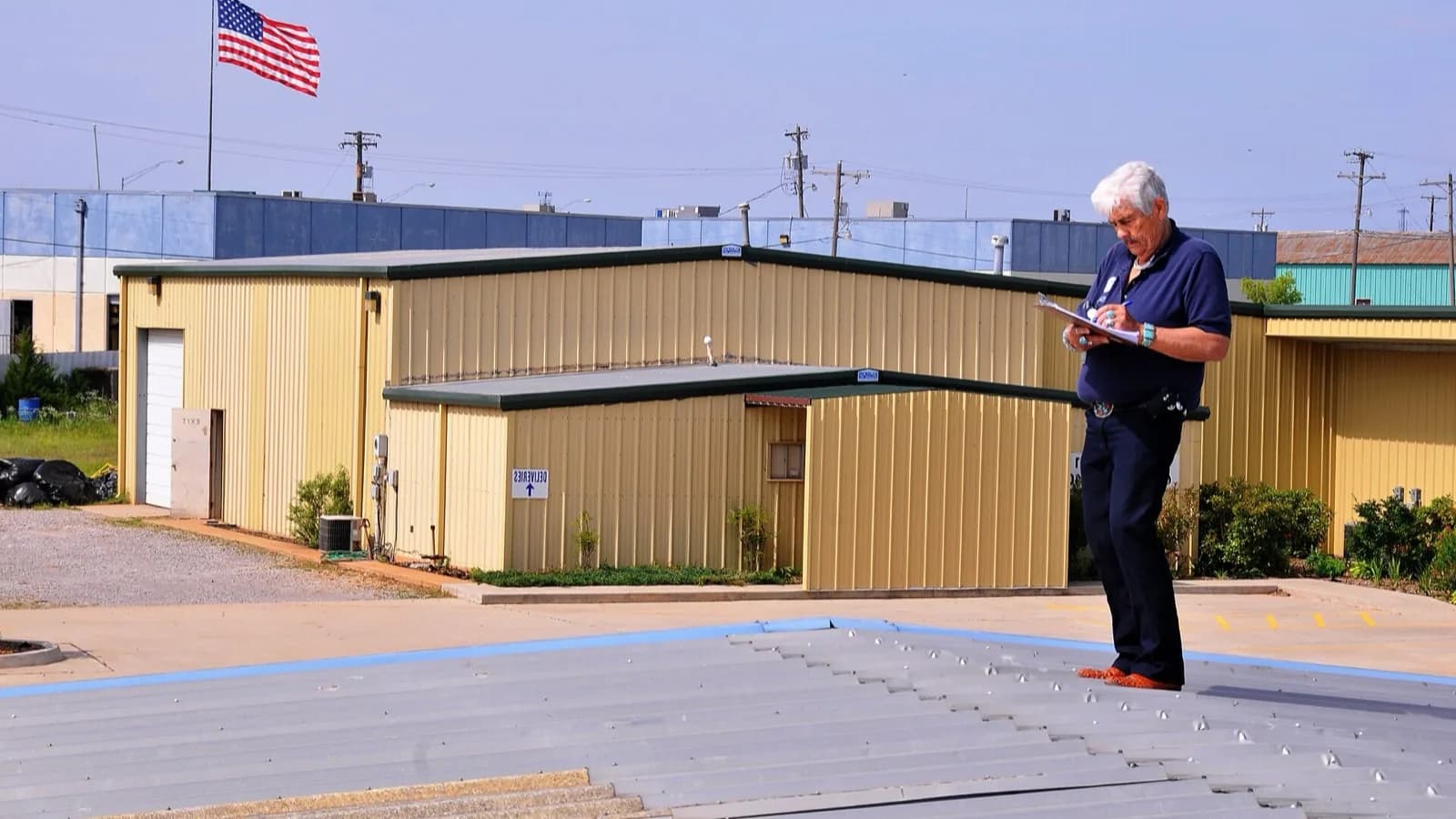
Photo: FEMA / Win Henderson — public domain
In short
Test square per slope, functional vs cosmetic damage, NOAA storm records, and matching rules — how public adjusters document a hail roof so the file holds on re-inspection.
The hail came through Plano at 7:42 p.m. on an April evening — 1.75-inch stones, logged by the local National Weather Service office. By morning the roof looks the same to everyone standing in the driveway: a few dented gutters, some spatter on the vents. What decides whether it is a $19,400 replacement or an $1,100 “cosmetic” repair check is not the damage. It is the test square — the six-shingle patch an adjuster chalks, photographs, and reads before anyone writes a number.

A hail roof is not hard to look at. It is hard to document in a way the carrier's own engineer cannot pick apart on re-inspection. The difference between a paid replacement and a denied "maintenance" finding usually comes down to four things done on the roof itself: a real test square, an honest read of what each mark proves, the storm's own record pulled before you climb, and the policy language you already know is waiting for you.
The test square is the argument, not the warm-up
Haag engineers built the test square in the 1960s, back when most assessments were cedar shingles, and it is still the procedure the carrier's retained engineer will run when they show up to contest your number. A 10-by-10-foot square is chalked on each directional slope — north, south, east, west — set away from tree cover and away from the path everyone walks from the ladder, because foot traffic and falling limbs both leave marks that read like hail until someone argues they are not.
Inside that square you count every strike and you put a hand on every shingle, because a hail bruise is as much felt as seen — the mat gives under a thumb where the stone broke the reinforcement. Then you extrapolate the count per slope. This is where most files quietly lose money. A north slope with nine fractures inside the square and a south slope with two is not "a damaged roof." It is one slope that carries a replacement and one slope the carrier will fight, and a public adjuster who writes them as a single roof-wide number hands the desk adjuster permission to average the whole claim down to the weak slope. Square each slope, photograph each chalk line with the strikes circled inside it, and the extrapolation defends itself.
What each mark actually proves
Not everything that shows up after a storm is compensable damage, and a file that treats every blemish as a hit is the easiest kind to discredit. Three categories do most of the work, and keeping them separate is what makes the rest of the file credible.
The functional standard. Haag defines hail-caused damage in functional terms: enough granule loss that asphalt is exposed and easily visible, or a fracture that runs through the back of the shingle — damage that shortens service life or opens a path for water. Spatter and surface marring that leave the shingle doing its job are a different conversation, and the carrier knows the difference even when the homeowner does not.
Spatter — the chalky oxidation marks hail leaves on soft metals like vent caps, gutters, fascia, and the fins of the AC condenser — is corroboration, not the claim. It proves a hail event hit this address, and the side it landed on tells you storm direction, which tells you which slopes to expect damage on. A mat fracture you can see through the back of the lifted shingle is the claim. Granule loss down to exposed asphalt is the claim. Thermal blistering, which looks like hail to a homeowner and to a hurried inspector, is not — it is a manufacturing and ventilation issue, and writing it up as hail is how a whole file gets thrown out on one bad photo.
| What you find | What it proves | Weight in the file |
|---|---|---|
| Spatter on soft metals | A hail event hit this address, and from which direction | Corroborating — supports the date and the slopes, not the payout |
| Fracture through the shingle back | Broken mat, shortened service life, water path | Compensable — the core of a replacement argument |
| Granule loss to exposed asphalt | Surface failure consistent with impact | Compensable when the pattern matches the storm |
| Blistering or foot-traffic scuffs | Manufacturing, ventilation, or handling — not hail | Exclude it yourself before the carrier does |
The storm wrote its own record — pull it first
Before the ladder comes off the truck, the date and severity of the loss are already documented by the government, for free. NOAA's Storm Prediction Center and the National Centers for Environmental Information keep the Storm Events Database, a state-by-state log of severe weather running from 1950 through early 2026, with hail size, time, and location for each report. Hail of 0.75 inch or larger is the National Weather Service's severe threshold, and the report will tell you whether the stones at this address were marginal three-quarter-inch ice or the two-inch stones that crack mats outright.
A carrier checks the claimed date of loss against that record as a first move. If the file says a March storm and the verified event was in April, the whole claim reads as opportunistic before anyone looks at a single shingle. Pull the report for the address, match it to the spatter direction on the soft metals, and the date of loss stops being something the adjuster can wave away.
The cosmetic exclusion and the present-tense trap
A growing share of policies no longer ask whether hail damaged the roof — they ask whether it stopped the roof from working. The cosmetic damage exclusion started in Texas, where the Department of Insurance adopted endorsement HO-145 for impact-resistant roofs in 1998. It went national when ISO introduced a cosmetic damage endorsement in March 2013 and AAIS followed that October. The language typically excludes "marring, pitting, or other superficial damage that alters appearance but does not prevent the roof from functioning as a barrier."
The phrase that decides these files is "does not prevent." In Cannon Falls Area Schools v. Hanover (D. Minn., October 21, 2025), the policyholder's experts argued that hail-dented metal panels had lost structural capacity and would fail sooner. The court read the exclusion in the present tense: the question is whether the roof currently fails as a barrier, not whether it will eventually. Reduced service life and future risk were held irrelevant to that wording. For a public adjuster, that ruling is a documentation instruction. On a policy with a cosmetic exclusion, dents alone lose. The file has to show present failure — fractures opening a water path, granule loss exposing the mat, interior moisture tied to the strike pattern — photographed and tied to the test square, not a gallery of cosmetic dimples.
Matching, before you sign the closeout
The last place a hail file leaks money is the slope nobody disputes. When the damaged slopes need new shingles and the discontinued product no longer matches the survivors, several states require the carrier to pay for a uniform appearance rather than a patch. Iowa's line-of-sight rule, codified at Iowa Administrative Code 15.44(1)(b), requires replacement of enough material to reach a reasonably uniform look within the same line of sight; Ohio's administrative code carries a comparable-appearance requirement. The documentation move is simple and easy to forget: photograph the undamaged slopes that sit in the same line of sight as the damaged ones, and note the shingle line and color so a matching argument is already in the file when the supplement goes in.
None of this is exotic. It is the same four habits every contested hail file rewards — a square per slope, an honest read of each mark, the storm's record pulled before the climb, and the policy's own language anticipated. claimOS keeps that record together so the photo, the chalk-line count, the NWS report, and the policy clause all sit on one claim instead of scattered across a phone and three folders. Public adjusters running this play at volume can see how the file comes together in claimOS for public adjusters, and how it stacks against the tools most firms outgrow in the public adjuster software comparison.
How many test squares should a hail inspection include?
One 10-by-10-foot square per directional slope at minimum — north, south, east, and west — placed away from tree cover and foot-traffic paths. Each slope is counted and extrapolated separately, because damage rarely lands evenly and a roof-wide average usually understates the worst slope.
What is the difference between functional and cosmetic hail damage?
Functional damage shortens service life or opens a water path: a fracture through the back of the shingle, or granule loss that exposes the asphalt mat. Cosmetic damage marks the surface without stopping the roof from shedding water. On policies with a cosmetic exclusion, only functional damage is typically paid, and courts have read that language in the present tense.
How do I prove the date of loss for a hail claim?
Pull the NOAA Storm Events Database report for the property's location and date. It records hail size and timing, and the carrier checks the claimed date against it. Match the verified event to the spatter direction on soft metals like vents and gutters to corroborate that this address was hit.
Does spatter on gutters and vents count as roof damage?
Not by itself. Spatter is oxidation that proves a hail event occurred and shows its direction, which tells you which slopes to inspect closely. It supports the date and the inspection map, but the compensable claim rests on fractures and granule loss to the roofing surface.
Can I get undamaged roof slopes replaced for matching?
In states with matching or line-of-sight rules, such as Iowa under Administrative Code 15.44(1)(b) and Ohio, the carrier may owe a reasonably uniform appearance when replacement shingles will not match the survivors. Photograph the undamaged slopes within the same line of sight and note the shingle line so the matching argument is in the file early.
Sources cited
- Haag's Test Square Method— Haag Global
- Protocol for Assessment of Hail-Damaged Roofing— Haag Global
- Storm Events Database— NOAA NCEI
- Cosmetic Damage Exclusion— Property Insurance Coverage Law Blog
- The Matching Problem in Property Insurance Claims— IRMI
The documentation lives where the claim does.
Photos, drying logs, scopes, and carrier correspondence land on the claim record as they happen, so the package you send the carrier is the file you actually worked.